
The Vatican Museums receive around 7 million visitors a year. The building was designed to display the papal art collection, not to handle 25,000 people in a single morning. The result is the Vatican shuffle: you arrive at 9:30, you queue, you walk through galleries at the pace of the group ahead of you, and 4 hours later you emerge from the Sistine Chapel having seen Michelangelo’s ceiling for 8 minutes through a forest of phone screens.
It doesn’t have to be this way. The Museums have a default route and an unofficial route, and the difference between the two is the difference between a great visit and an endurance test. This article explains what the order of visit actually is, why most tours do it backwards, what each main gallery is worth slowing down for, and how to pick a tour that lets you see the Sistine Chapel as it was meant to be seen.
The short version. The Sistine Chapel is at the end of the official route. Every tour group, audio guide and self-guided visitor follows the same route. The bottleneck at the chapel happens between 11 a.m. and 1 p.m. To see it properly, either enter at 7:30 a.m. with a breakfast-access tour and go directly to the chapel first, or invert the entire route by starting at the chapel and walking backwards through the galleries. Standard 9 a.m. entrance + standard route = standard frustration.
Quick check: which kind of Vatican visit suits you?
- How much time do you really have?
Under 2.5 hours: do the express route (Map Gallery, Raphael Rooms, Sistine Chapel). 4 hours: the full standard route. 5-6 hours: the standard route plus St. Peter’s Basilica next door. More than 6 hours is too much for one day; you’ll lose attention before you reach the chapel.
- Are you a morning person?
If yes, take an early-access tour (7:30 a.m. entry, sometimes with breakfast included). This is the single biggest quality-of-experience upgrade available. If you can’t physically get there at 7:30, plan a late-afternoon visit instead (last entry 4 p.m., much quieter from 2 p.m. onwards).
- How much do you know about Renaissance art?
If you can name Raphael, Michelangelo and Botticelli but not much else, a licensed guide is worth the cost: the Vatican Museums are over 70,000 catalogued works, of which 20,000 are exhibited, and the audio guide treats them all as roughly equal. A guide tells you which 15 actually matter.
Why the Vatican without a plan feels like waiting at the airport
The official route through the Vatican Museums is a one-way march from the entrance, through 7 kilometres of galleries, ending at the Sistine Chapel. It’s set up this way for two reasons: the Sistine Chapel has limited capacity and is the emotional climax, and the route forces visitors past the major collections in a roughly chronological order.
The problem is that millions of people doing the same route at the same time create predictable bottlenecks. The choke points are: the Gallery of the Maps (around 11 a.m.), the Stanze di Raffaello (Raphael Rooms, 11:30-12:30), and the Sistine Chapel itself (12:00 to 1:30 p.m.). If you walk the standard route starting at 9:30 a.m., you’ll hit all three of these at their worst moment.
Three specific things get lost without a guide or a plan:
- The actual purpose of the collection. Most popes added what they personally valued, so the museums are a 500-year record of papal taste rather than a curated art history. The Pio-Clementino sculptures (Greek and Roman) were collected by 18th-century popes who wanted to compete with the British Museum.
- The Stanze di Raffaello. The Raphael Rooms are right before the Sistine Chapel. By the time most visitors arrive, they’re already tired and skip them, even though the School of Athens is in there—the painting half of every art history textbook reproduces on its cover.
- The fact that the Sistine Chapel is part of a chapel. Many visitors don’t realise it’s still an active liturgical space. Photography is forbidden, talking is officially forbidden too (rarely enforced), and you’re standing where the conclave votes for new popes. That context changes the experience.
The official route vs. the locals’ route
The official route (what 90% of visitors do)
- Entrance and Pinecone Courtyard
- Pio-Clementino Museum (Greek and Roman sculpture, including the Laocoön)
- Gallery of the Candelabra
- Gallery of the Tapestries
- Gallery of the Maps
- Stanze di Raffaello (Raphael Rooms)
- Modern Religious Art
- Sistine Chapel
- (Optional) St. Peter’s Basilica via the connecting passage
Walking this route at standard pace takes 3.5-4 hours. If you start at 9:30 a.m., you’re in the Sistine Chapel at 12:45 p.m., the worst possible moment.
The locals’ route (what licensed guides do when given freedom)
- Early entry at 7:30 a.m. (with breakfast access tour)
- Walk through galleries quickly, save context for later
- Sistine Chapel at 8:30-9:00 a.m., when there are 200 people instead of 2,000
- Walk backwards through Stanze di Raffaello (much quieter)
- Gallery of the Maps (now empty)
- Pio-Clementino and Egyptian Museum (full context, no rush)
- Exit through the Bramante Staircase
Same building, same time, completely different experience. The trick: the Sistine Chapel is the only point everyone has to cross; everything else is empty when the chapel is full and vice versa.
Did you know? The breakfast access tickets allow entry at 7:30 a.m., one hour before standard opening. Tour groups using this option are typically the only people in the Museums for the first 45 minutes. The price is roughly €70-€110 on top of standard admission, but it’s the single best investment in the entire visit. Tickets are limited and sell out 3-4 weeks ahead in high season.
The 8 stops that actually matter
| Stop | What to look at | Time to spend |
|---|---|---|
| Pio-Clementino Museum | The Laocoön and the Apollo Belvedere. Both shaped European sculpture for 400 years. | 25 min |
| Gallery of the Tapestries | Brussels-made tapestries from Raphael’s designs. The Resurrection tapestry uses an optical trick: Christ’s eyes follow you across the room. | 15 min |
| Gallery of the Maps | 40 maps of Renaissance Italy painted on a ceiling, commissioned by Pope Gregory XIII (the one who made the Gregorian calendar). | 15 min |
| Stanze di Raffaello | Four rooms painted by Raphael. The School of Athens is here. Most visitors walk past in 5 minutes; spend 30. | 30 min |
| Sistine Chapel | Michelangelo’s ceiling (1508-1512) and Last Judgment (1536-1541). Sit on the perimeter benches; you’ll see twice as much from there. | 20-30 min |
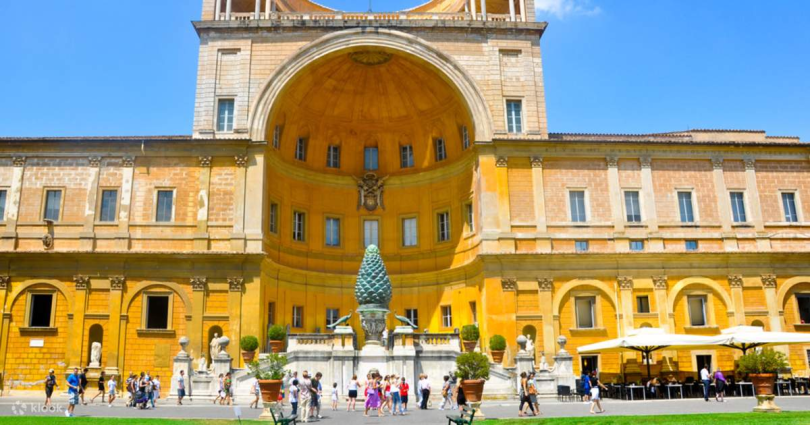
| Pinecone Courtyard | The “Sphere within a Sphere” sculpture, contemporary, contrasts with everything around it. Worth a 5-minute pause. | 5 min |
| Bramante Staircase | The exit. Photograph it from the top, not the bottom. | 5 min |
| St. Peter’s Basilica | If your tour includes the passage from the Sistine Chapel directly to St. Peter’s, take it. Otherwise queue separately (45-60 min wait). | 45 min |
How much time you really need
Express visit (2.5 hours): Pio-Clementino, Map Gallery, Raphael Rooms, Sistine Chapel. Skip the rest. Works for travellers who already feel cultured-out from other Rome sites.
Standard visit (4 hours): The full route at a reasonable pace, with a guide pointing out 15-20 key works. The right balance for first-time visitors.
Full day (5-6 hours): Vatican Museums + Sistine Chapel + St. Peter’s Basilica via the connecting passage. Add a lunch break. Beyond 6 hours, attention drops faster than you save time.
Two days: Recommended only for serious art-history travellers. The Vatican Museums on day one (focusing on Greco-Roman + Egyptian + Maps), Sistine + Raphael Rooms + St. Peter’s on day two with a different guide.
How to choose a tour: green flags and red flags
Green flags. Specific entry time stated (e.g. “7:30 a.m. early access” or “8:00 a.m. before public hours”). The guide is described as licensed by the Vatican State (different from Rome’s regional license). Group size cap in writing (max 8-12 for small group, 1-6 for private). Cancellation policy at least 48 hours.
Red flags. “Special access” without a stated time. Tours under €45 promising “skip-the-line” plus a guide (mathematically the math doesn’t work). “Guide” without specifying “licensed” or “Vatican-authorised”. Generic photos of the Sistine Chapel in marketing (no photography is allowed inside).
The operators that actually run Vatican private tours
- Walks of Italy runs a Pristine Sistine breakfast tour, one of the most consistently rated early-access options. English mostly.
- Through Eternity offers small-group academic tours, strong in art-historical depth.
- City Wonders handles the volume end of the market with reliable execution and Spanish availability.
- For travellers who want a fully private day with a Spanish or French speaking licensed guide, pickup at the hotel, and the day shaped to include the Vatican plus part of Rome in the afternoon, agencies like Tour Travel & More handle that format. You can see a private tour of Vatican City with skip-the-line entrance and licensed guide for the standard four-hour format, with the option to extend into a full day combining the Vatican and the Colosseum under the same operator.
Getting to the Vatican Museums
The nearest metro stop is Ottaviano (Line A), a 7-minute walk from the entrance. Buses 49 and 32 stop right outside. A taxi from the centre of Rome is around €12-€15.
The entrance is on Viale Vaticano, around the back of the city walls—not next to St. Peter’s Square. This catches a lot of first-time visitors out; allow 15 minutes more than Google Maps suggests if you’ve never been.
What to wear
The Vatican enforces a dress code: knees and shoulders must be covered. Sleeveless shirts, shorts above the knee and short skirts will get you turned away at the security check. This is non-negotiable and not just for women: men in sleeveless tops are also stopped. A light cotton scarf or a long-sleeved top in your bag solves it.
Frequently asked questions
Are the Vatican Museums open on Sunday?
Almost always closed, with one exception: the last Sunday of every month, entry is free from 9 a.m. to 12:30 p.m. Free entry means a queue that wraps around the building from 6 a.m. and a Sistine Chapel packed to legal capacity. Worth it if you’re on a tight budget; avoid otherwise.
Can I take photos in the Sistine Chapel?
No. Photography is forbidden, video too. Sony has the exclusive contract for image rights from the restoration. Guards enforce this with reasonable consistency. Photos in the rest of the Museums are allowed (no flash).
Is the breakfast access tour worth the extra cost?
Yes, if you can get up. The 7:30 a.m. entry means the Sistine Chapel before the crowds, the Raphael Rooms with breathing room, and the rest of the day free. The price premium (€70-€110 over standard) is the best-value upgrade in the Vatican tour market.
Can I do the Vatican and the Colosseum in one day?
Yes, with a full-day private tour that coordinates timings. Vatican in the morning (early access if possible, 3-4 hours), lunch near the Castel Sant’Angelo, Colosseum and Forum in the afternoon (3 hours). Total 8-10 hours including transfers. Not recommended without a guide who manages ticket times.
How long does the Sistine Chapel visit actually last?
Standard groups spend 15-20 minutes inside. Private tours often stop at 20-30. There’s no posted time limit, but guards move groups along when the chapel reaches capacity. Sitting on the perimeter benches buys you another 10 minutes; they don’t move people who are seated.
Is there a connecting passage from the Sistine Chapel to St. Peter’s?
Yes, but it’s only open to authorised groups (most licensed tours include access). Self-guided visitors are routed back through the Museum exit and must queue separately to enter the Basilica. This saves 45-60 minutes; it’s one of the biggest practical benefits of booking a tour over going alone.
What’s the best day of the week to visit?
Tuesday and Thursday are the calmest. Wednesday morning has the papal audience in St. Peter’s Square, which means the Square is closed but the Museums are quieter. Saturday is the worst weekday. Sunday is closed except the last of the month.
Are guided tours available in Spanish?
Yes, but availability is tighter than English. Spanish-speaking Vatican-authorised guides are in higher demand than supply in summer. Book directly with an agency that confirms the guide language in writing.
The verdict
The Vatican is not ruined by crowds, but the experience changes by an order of magnitude depending on when you enter and which way you walk. The two strategies that consistently work are early access (7:30 a.m. entry with a breakfast tour) or late afternoon arrival (after 2 p.m. with last entry at 4 p.m.). Standard 9:30 a.m. entry with the standard route is the worst possible combination, and it’s what most marketplace tickets default to.
If you’re combining the Vatican with the Colosseum or fitting it into a tightly planned Rome trip, the strongest formats are an early-access small-group tour with a licensed guide, or, for travellers who want a fully tailored day with hotel pickup, a guide in their language and the option to expand the day into Rome’s classical sites, a full-day private tour combining the Vatican and the Colosseum with licensed guide and luxury vehicle. Either way, pick the time slot before you pick the operator; the time decides what you actually see, the operator decides how well you see it.